

Not getting your receivables paid. As a business owner, you obviously want to avoid that as much as possible. Debt collection means collecting money. Receiving timely payment of your outstanding invoices is good for your business in every way. So how do you make sure you get paid? We help you collect effectively, not only by providing you with valuable information about your debtor, but also, should the worst come to the worst, by helping you choose the right debt collection partner for your specific situation and inform you about the steps involved in the debt collection process when it becomes necessary to outsource debt collection.
Few things are as frustrating as a non-paying buyer. The better you follow up on your outstanding invoices, the faster they will be paid. You should not wait too long with collecting your claim, especially if your customer does not make firm commitments. In addition, when non-payment occurs, it is important to obtain as much information as possible about the customer in question.
If a payment appears to be permanently outstanding, there comes a time when it is necessary to engage a debt collection agency. The choice of a debt collection partner, in addition to the right timing, is very important in this regard and depends on your specific situation. It is also advisable to find out more about no cure no pay debt collection, for example. There may be a condition that applies, meaning that you still have to pay if the debt cannot be collected. It is therefore wise to thoroughly research the companies that offer debt collection services, just as you would with a potential customer. Not sure where to start? We are happy to help you on your way.
Debt collection is the process of formally claiming an outstanding invoice, usually after previous reminders have been unsuccessful. From this point onwards, the collection of your claims is handled in a structured manner, with the aim of still obtaining payment. This is first done through an amicable approach and, if necessary, through legal action. For many entrepreneurs, this is the point at which it may be wise to hand over the debt collection to a party that specialises in this field. Read here more on why it is important to have enough cash liquid.
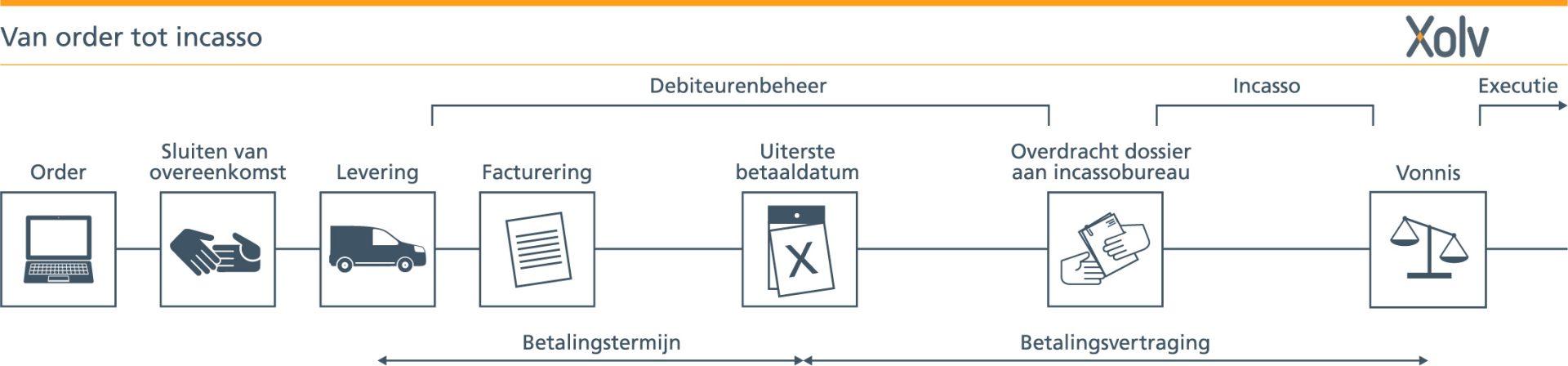
The entire accounts receivable management process is important. It starts with you obtaining detailed information about a potential customer in advance. In this article, you can read all about debtor management.
What is the difference between amicable and judicial debt collection? Both involve handing over a debt collection. Out-of-court debt collection is an attempt to collect the money from an outstanding debt via a collection agency by sending a reminder. If payment is still not forthcoming, it is important to proceed to legal collection. Judicial collection means taking legal action by engaging a bailiff's office. They have more legal powers than a collection agency.
Collections are often outsourced to the credit insurer where the insurance is placed. In case of a non-covered claim, we always advise you to contact us. Simply because we can draw from more sources. Sometimes it may be advisable to transfer your collection to another collection partner. This may differ for each collection.
We can help you trace non-paying customers where we can check various databases. In addition, we advise you on the action(s) to be taken and engage a collection agency or collection lawyer to collect the claim. Maintaining the relationship with the customer is key in this process.
As indicated earlier, it is very important to choose the right collection partner to collect your debt. We have a large network of debt collection partners and advise which party is most suitable for your specific situation. This depends on, among other things:
Want to know more?
Concise product summary (PDF)?
A collection process usually starts with a friendly payment reminder. If payment is not made, a reminder follows. If payment is still not made after that, a collection agency can be called in. This will first try to collect the outstanding amount in a friendly manner, possibly followed by legal action if necessary.
Debt collection means collecting outstanding payments. During a collection process, the customer is requested to still settle their outstanding payments, usually through payment reminders or with the help of a collection agency. Debt collection is about taking a structured and formal approach to unpaid invoices, with the aim of collecting the outstanding amount.
A debt collection agency is engaged when a payment appears to be outstanding. In the case of amicable debt collection, the debt collection agency attempts to collect the money from an outstanding claim by sending the debtor a reminder. If payment is still not made, it is necessary to proceed to judicial debt collection. At that stage, legal action is taken by a bailiff's office, which has more legal powers than a debt collection agency.
You outsource debt collection when a payment appears to be permanently outstanding. Especially if your customer does not make any firm commitments and previous follow-ups on your outstanding invoices have not yielded any results, it is important not to wait too long to collect your claim. At that point, it may be wise to engage a debt collection agency or other debt collection partner.