
Concerns
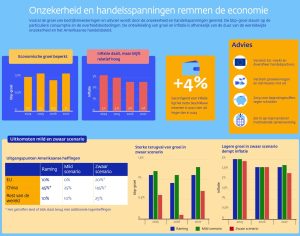
How our economic growth will develop in the coming years depends largely on the final level of import tariffs. High import tariffs will cause economic growth to decline further. Inflation appears to be falling somewhat at present, but is still relatively high. However, uncertainty and declining consumer confidence mean that Dutch households are saving a lot. Nevertheless, private consumption is still growing due to continued growth in real incomes. More worrying is the decline in business investment. This will have negative consequences for the Dutch economy in the longer term.
New cabinet
The elections have just taken place and they show that the Netherlands needs to change course. The elections indicate that the Netherlands is shifting more towards the centre and that there is a good chance of a centre-right cabinet being formed. The new government will face a considerable challenge in stimulating the business community to invest again and in boosting economic growth. The new government must also put the Netherlands back on the map within the EU and further stimulate exports.
Number of bankruptcies
Looking at the number of bankruptcies in the Netherlands, we see a positive development this year, namely a 12 per cent decrease compared to 2024. However, this makes the Netherlands an exception in Europe. In all other countries, the number of bankruptcies is rising, with Germany even heading for a record number of bankruptcies this year in 10 years. Globally, the number of bankruptcies will increase by 5 per cent this year. Because many Dutch companies export and are also largely dependent on developments in Germany (currently the weakest performing economy in the EU), this is expected to have an impact on the Dutch economy. It is likely that the number of bankruptcies in the Netherlands will increase next year.